Tell us about the job
Takes about a minute. No obligation.
A contractor quoting a water heater installation in Hamilton County has to account for what the local climate regularly asks of equipment, not what a catalog assumes. 137 severe weather events were recorded in Hamilton County, Indiana between 2015 and 2024. At that rate, severe weather is a standing condition here, and a water heater sized or installed without factoring in that load starts behind. Connections, pressure relief components, and the unit's placement all need to be specified for a place where the grid and the elements push hard on a regular basis.
Half the homes in Hamilton County, Indiana were built in 2001 or earlier (2020-2024 ACS 5-year). A house built around that time was wired with electrical service sized for appliances that drew loads comparable to what a modern water heater requires, so the panel a contractor finds in a Hamilton County home is rarely the obstacle that drives up the scope or the price. The ductwork question does not apply to water heater work, which leaves the electrical connection and the existing plumbing configuration as the two variables a contractor prices around. Both are things they can see before the new unit arrives.
What Gets Installed With a New Water Heater
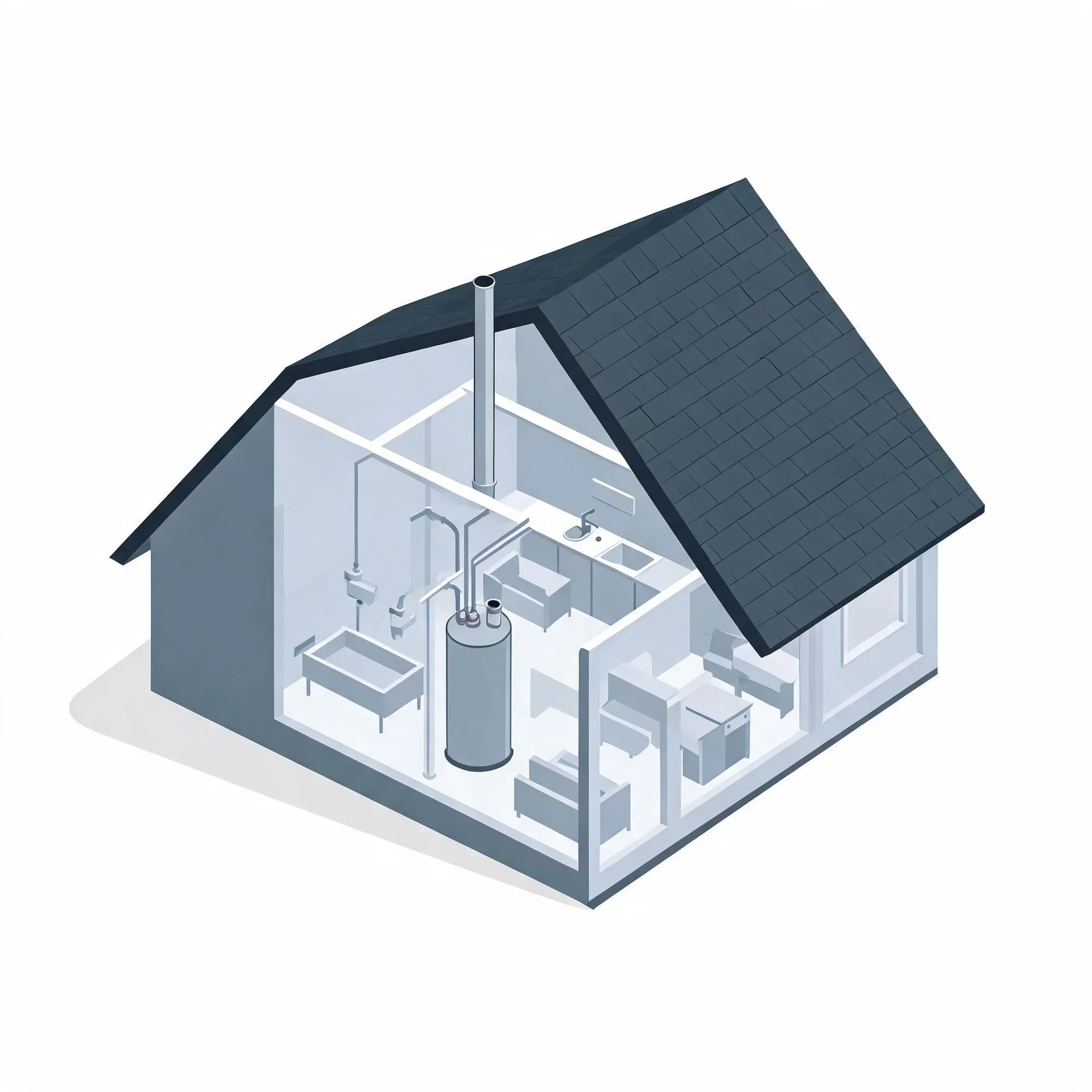
The storage tank is the piece most homeowners picture first. It sits in a utility room, basement, or garage and holds the water that gets heated and sent to every fixture in the house. Attached to the tank are the inlet and outlet pipes, a pressure relief valve, and the drain valve at the base.
The heat source, whether a gas burner assembly at the bottom of the tank or electric heating elements inside it, is what a contractor fits and connects during installation. A flue or exhaust vent runs from the tank to the outside on gas models, and a dedicated supply line ties the unit into the home's cold water feed.
The drawing shows a typical layout, and a licensed contractor determines exactly what applies to this house.
Find a contractor in Hamilton CountyHamilton County, Indiana, by the numbers
137 severe weather events were recorded in Hamilton County, Indiana between 2015 and 2024.
NOAA National Centers for Environmental Information, Storm Events Database, bulk CSV export, events 2015-01-01 through 2024-12-31.Half the homes in Hamilton County, Indiana were built in 2001 or earlier (2020-2024 ACS 5-year).
U.S. Census Bureau, 2020-2024 American Community Survey 5-Year EstimatesHamilton County, Indiana holds 144,746 housing units (2020-2024 ACS 5-year).
U.S. Census Bureau, 2020-2024 American Community Survey 5-Year EstimatesOwners occupy 76.1% of the occupied homes in Hamilton County, Indiana (2020-2024 ACS 5-year).
U.S. Census Bureau, 2020-2024 American Community Survey 5-Year EstimatesSevere Weather Events in Hamilton County
Hamilton County weather puts real demands on water heating equipment, pushing it harder during temperature swings and extended cold periods. How often those conditions arrive is a local fact, and it shapes what a contractor installs and how they size it.
137 severe weather events, 2015–2024. Source: NOAA National Centers for Environmental Information, Storm Events Database.